
Palsubuuk! (2023) – The Disaster of Social Media Hoaxes
- Ailsa Luthfia Indrasari Laksana Putri
- Ailsa Luthfia Indrasari Laksana Putri
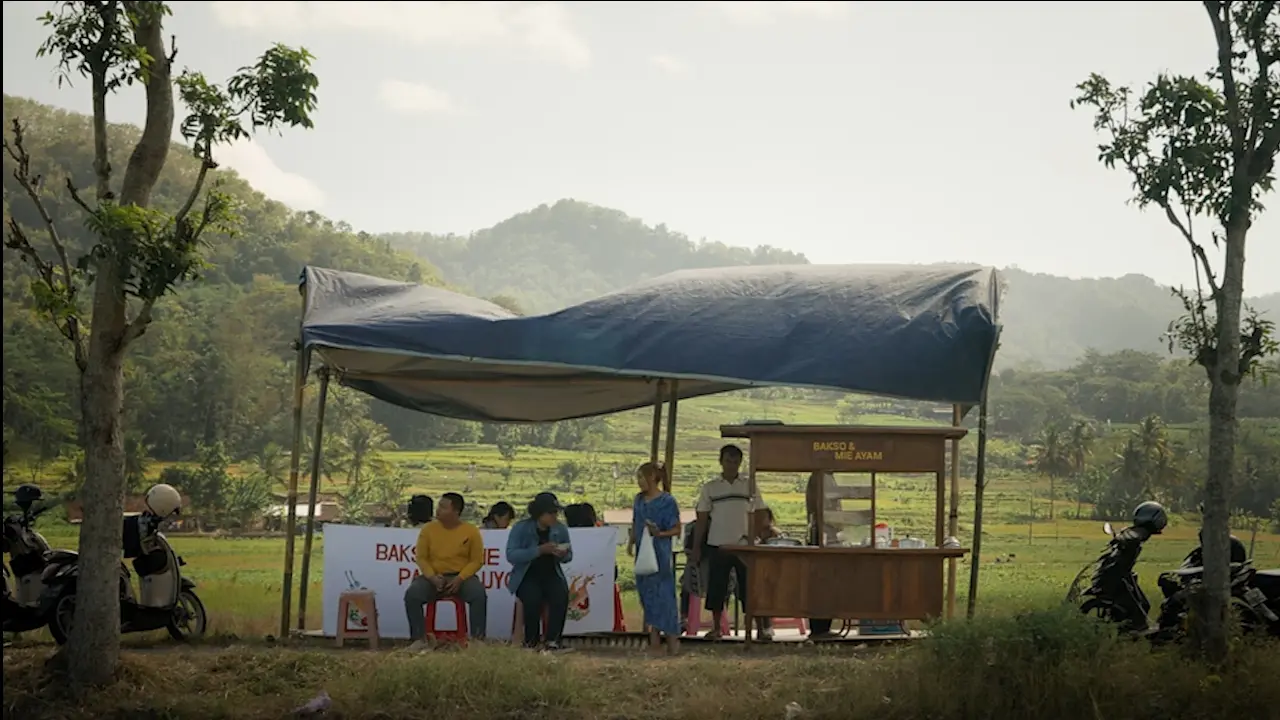
Amid the rapid advancement of technology, there are still people who are not fully prepared to face it. This lack of preparedness is clearly portrayed in Palsubuuk! a film that tells the story of the downfall of a meatball stall caused by a single irresponsible social media post. Through this film, we do not merely witness a cliché comedy-drama, but also a real issue that feels very close to everyday life.
A warm bowl of chicken noodles and meatballs made by Waluyo in Wedikere village was supposed to be a comforting place to eat. His business was always crowded thanks to his hard work every day. However, problems begin with accusations that are often directed at food vendors, namely the use of mystical charms to attract customers. When a customer feels that the taste of the food changes after being packed and taken home, reasonable explanations such as swollen noodles or cooled broth are immediately forgotten. Instead, the customer quickly concludes that Waluyo uses mystical charms.
.

The situation grows worse when the suspicion is uploaded as a post on social media. The negative opinion spreads rapidly online, damaging the stall’s reputation and provoking the villagers’ anger. The film boldly criticizes society through the appearance of a shaman summoned by the villagers to drive away evil spirits. In this part, the film exposes people who take advantage of others’ ignorance about mystical matters for personal gain. The so-called spiritual expert turns out to be a fraud who exploits the villagers’ panic merely to gain popularity and attract viewers during livestreams.
The story of Waluyo’s business collapsing because of a hoax feels painfully real. The events in the film reflect the toxic patterns that often happen around us. Many local food businesses have been forced to shut down simply because of viral negative reviews unsupported by concrete evidence. Social media is indeed useful as a space for self-expression, yet ironically, it is often used to bring others down. This phenomenon frequently appears when people or content creators make careless criticism for personal benefit, ultimately harming culinary business owners without any clear social consequences for the creators of the hoaxes.

The saddest injustice is shown in the final part of the film, when Waluyo’s stall is destroyed and bankrupt, while the person who spread the hoax easily uploads a clarification video. The reactions of the netizens in the film, who condemn the perpetrator, represent the audience’s frustration. There is a clear imbalance when a simple apology on a phone screen is considered enough to compensate for someone’s lost livelihood. In the end, the film serves as an important reflection that no matter how advanced society becomes, empathy should never be left behind.
by Ailsa Luthfia Indrasari Laksana Putri
by Ailsa Luthfia Indrasari Laksana Putri
Editor Arina Chuuriyyah Herawati
Editor Arina Chuuriyyah Herawati
Translator Asi Dewiana Sandra Putri

Comments • 0
Write your comment
Comments • 0